Metric
Shots cut to fixed lengths, regardless of content. The beat-synced edit is its modern form. Clear, but monotonous unless the length changes at a turning point.
Every cut answers a question: what should the viewer see next, and when? Walter Murch, editor of Apocalypse Now and The English Patient, offered a famous ranking in his book In the Blink of an Eye. His “rule of six” weighs emotion highest (51%), then story (23%), rhythm (10%), eye-trace (7%), two-dimensional screen plane (5%) and three-dimensional space (4%). The numbers are deliberately playful, but the order is useful: if you must sacrifice something, give up spatial continuity before you give up the feeling of the moment.
The Kuleshov effect, from early Soviet experiments by Lev Kuleshov, shows the other half of the story. The same neutral face reads as hungry, grieving or tender depending on the shot placed next to it. Meaning lives between shots. That is why a transition is never just a join; it is an argument about how two images relate.
None of these is “correct”. Each solves one problem and creates another.
Replaces one image with another instantly. The workhorse of almost all editing.
Fast, invisible when motivated, and honest about time.
Exposes continuity errors. Cut on an action to hide them: the eye follows movement across the join.
Links two shots by shape, motion, colour or sound. Stanley Kubrick's bone-to-satellite cut in 2001: A Space Odyssey is the textbook case.
Creates meaning and memorability in a single frame.
Needs planning while shooting, and repeated use turns it into a gimmick.
The next shot's audio starts before its picture.
Pulls curiosity forward; the viewer wants to see the source of the sound.
On small speakers, a quiet lead can disappear. Check at low volume.
The previous shot's audio continues over the new picture.
Lets reactions land and keeps conversations flowing.
Overlapping too long can blur who is speaking.
Cuts within the same framing, skipping time. Popularised by Jean-Luc Godard's Breathless and now standard in talking-head videos.
Compresses pauses and adds urgency.
Constant jump cuts can feel breathless; a small punch-in every few cuts softens them.
Hides the cut inside motion blur or a sudden speed change. Edgar Wright's films use rapid versions for comic energy.
Signals a jump in place or time with energy.
Strong style signature; direction and speed must match across both shots.
Sergei Eisenstein described several methods of montage in the 1920s. They still map neatly onto short-form editing.
Shots cut to fixed lengths, regardless of content. The beat-synced edit is its modern form. Clear, but monotonous unless the length changes at a turning point.
Cuts follow movement within the frame. Feels natural and propulsive, though it depends on footage with visible motion.
Shots grouped by emotional tone: light, colour, texture. Quiet and atmospheric; risks feeling aimless without structure.
Combines metric, rhythmic and tonal cues. Rich and layered, but hard to diagnose when it goes wrong.
Two images collide to imply an idea. Dziga Vertov's Man with a Movie Camera shows how far it can go. Easy to overstate.
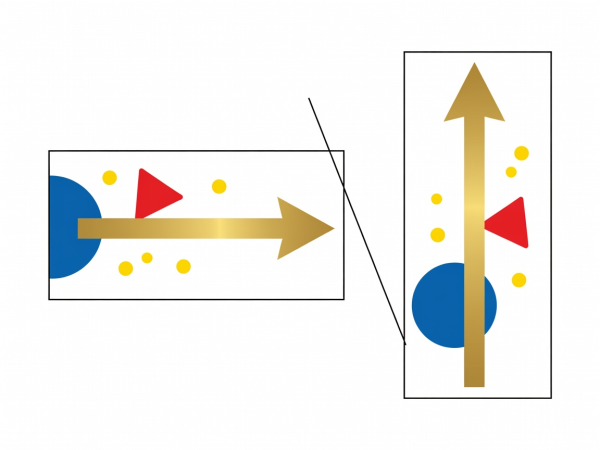
Platforms such as TikTok, Instagram Reels and YouTube Shorts change a few pressures. The first second carries more weight, so open on motion or a question rather than a title card. Vertical 9:16 framing gives less horizontal room for match cuts based on lateral movement; vertical motion and scale changes often work better.
Many viewers watch without sound, so a J-cut that relies on audio may need a caption to do the same job. Loops matter too: an ending that flows back into the opening can reward re-watching, but only if it feels earned rather than forced.
None of this makes long-form craft obsolete. It just changes which trade-offs bite hardest.
When you are unsure about a transition, duplicate the sequence and try the plainest option: a straight cut at the end of the action. Watch both versions without stopping. If the fancier transition does not clearly improve the feeling or the story, keep the simpler one. Then ask a reviewer which version they remember, not which one they liked; memory is a better signal of impact. Bring the result to the feedback guide.